

What to Look For in a Burr Mill Coffee Grinder
Burr grinders provide a more consistent grind and can be adjusted to achieve an exact size of the particle. Burr grinders are more expensive than blade models. Some models with lower prices use false burrs, like the DF64.
These machines are often referred to by the name of a pepper mill. They use burrs of steel which are conical or flat to crush food into smaller pieces.
Capacity
The capacity of burr grinders is vital to think about as it directly affects the quality and taste of the coffee that is brewed. Burr grinders crush the beans between two burrs, which may be flat or conical in shape. This ensures that the flavors and oils are properly extracted during the brewing process by creating uniformly sized ground. It also helps avoid over-extraction, which can produce unclean and sour coffee that is sour and muddy.
Burr grinders have a variety of grind settings that allow you to adjust the consistency for various types of brewing. For example coarser grinds work best for cold brew and French press while fine grinds are ideal for espresso drip and drip coffee. Additionally, the majority of burr grinders are able to alter the speed of grinding to meet your individual preferences.
Some grinders have removable burrs that can be replaced when they get dull. This is a great option for consumers who want to preserve the quality and quantity of their coffee grounds while decreasing the cost and time required to grind batches of coffee. Some manufacturers may also recommend changing the burrs at specific intervals based on the amount of coffee that the grinder is used to ground.
In contrast to blade grinders, which use a spinning metal blade to chop up the beans, burr mills create less heat when they grind and generate a low static charge. The lower the temperature of the grinding process, the more flavor and aroma of your coffee.
While most burr grinders are electric however, there are a few manual models for those who prefer to grind their own beans at home. These grinders use an electric crank to turn the burrs. They are quieter and easier to transport than electric counterparts. However, they will take longer to grind beans than their electric counterparts.
Many coffee enthusiasts prefer a high-quality burr grinder for their morning cup of joe. Some people will opt for a cheap grinder from the local big-box store, while others spend more on a properly constructed burr mill that will provide them years of excellent brewed coffee. With so many options on the market it is essential to investigate your options and find a grinder that meets both your requirements and budget.
Adjustability
It is important to be able adjust the settings of a burr mill, as the optimal size of grind for different methods of brewing can differ. A good burr mill will provide consistent results across all grind settings. Test every setting to determine the one that suits you best. best budget espresso grinder has 18 different settings. From fine for drip coffee or espresso, to coarse for French Press and cold brew. It also features a built-in timer that can be set to stop grinding after a preset amount of time.
When you adjust the size of your grind be aware that the production of heat is a problem that can affect the flavor of your coffee. You should choose a grinder with large grinding burrs and slow speeds to minimize the risk of this. The former can help keep essential oils in beans, while the latter assists in dispersing heat during the grinding process.
When adjusting the burr grinder, you should be aware of the noise level. When the burrs come in contact, a loud sound can be heard. This means that the space is small. A grinder that makes a loud chirping noise should be calibrated using the adjustment dial until there is no more chirping.
The design of the burr grinder also affects its performance. For example, the Fellow Ode Gen 2 has flat burrs. They are much easier to calibrate compared to conical burrs. This style is more expensive than other options.
Manual burr grinders require more effort from the user, however they provide greater control over the final grind size and consistency. Electric burr grinders are convenient and speed, but are more likely to give inconsistent results due to the fact that they are powered by motors. These grinders are also more expensive than manual models. Choosing between a manual or electric model will come down to your personal preferences and budget.
Noise
In contrast to blade grinders, which grind abrasive components between rotating rough surfaces that can't be adjusted to the size required, burr mill grinders use a pair of fixed, revolving abrasive surfaces to produce uniformly-sized particles. This allows for more control over the final grind, which is crucial to ensuring even extraction during brewing. Burr grinders are available both electric and manual models. The choice between the two is mostly dependent on the needs of the user and preferences. Things like durability, portability, and price are the primary factors in choosing the manual grinder, while convenience, speed and other features impact the selection of an electric model.
Burrs are quieter than blades. The motor that drives the burrs is the primary source of noise. The quietest grinders use direct drive technology that connects the motor directly to the burrs. This reduces friction between the abrasive surfaces and the beans, as well as heat generation that can dissipate aroma and flavor.
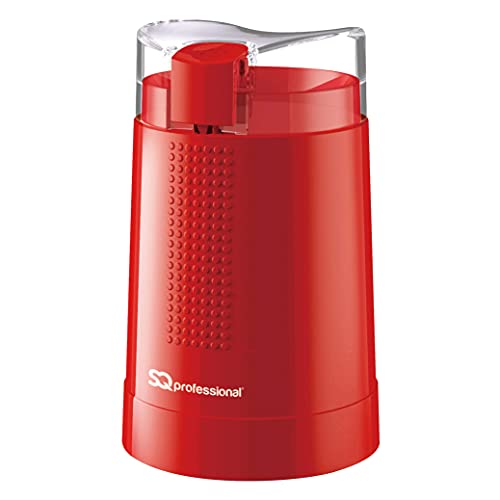
Other grinders achieve similar results by connecting a high speed motor to set gears which reduce the number of minutes of rotation. While these grinders are very noisy when compared to direct drive counterparts, they generate less heat and static than blade grinders.
The most well-known and efficient grinders have a pair of flat burrs that can be adjusted to size. This type of grinder creates a very consistent, uniform grind that can be adapted to fit a variety of methods of brewing. The Moccamaster KM5 is a good example of a flat burr grinder. It is equipped with a powerful yet efficient direct-drive motor that grinds coffee quickly and without heating the beans.
For a slightly less expensive alternative, a coffee mill equipped with a conical burr can provide a similar result. The larger diameters of these kinds of grinders tend to generate an unimodal grind distribution than their smaller counterparts, however, the differences don't seem to be related with the degree of uniformity or unimodality the grinder is able to create. This is probably due to the design and coating of the burrs, rather than the number of rotations per minute.
Maintenance
If you have a burr grinder, it's essential to clean the grinding chamber regularly and also conduct a thorough cleaning. This will help you keep the grinder running efficiently and ensure that there's no accumulation of old coffee beans. This could cause your grinder to slow down or even clog. Urnex Grindz can be used to clean surface oils and stale grindings. However, for an effective cleaning, you'll have to open the grinder and clean the chamber.
The frequency of deep cleaning is contingent on how often you use your grinder. If you prepare two to three cups of coffee a day at home, you will have to perform a deeper cleaning more frequently than someone who makes just one cup of coffee. The type of roast you choose to use will affect how much oil is produced and has to be cleaned, since darker roasts are more likely to produce oils.
If you decide to clean your grinder, disconnect it first, and then remove the bean hopper (if applicable) and the burr carrier on the top. To access the grinding chamber, you'll need to unscrew the components.
Once you've removed these parts, clean the hopper and the burr carrier on top with warm soapy water, soapy water, and a soft brush to get rid of any coffee dust and oils that may have accumulated. You can also use compressed-air or a specialized vacuum cleaner to clean these parts without getting them wet.
Before you do a deep clean, consider picking up some burr cleaning pellets. They are designed to eliminate the oils that a coffee grinder can create, and are safe for your burrs. Rice can cause damage to your burrs, voiding any warranty you might have and damaging the grinder.
After cleaning the chamber and burrs, reassemble the grinder by screwing in the upper burr carrier. Use a small amount of lubricant while doing this to assist the screw in place smoothly and easily. Do not overdo it, however you don't want excess lubricant to contaminate the grinding chamber.